2026 ABDC Network Awards
The ABDC Annual Network Awards recognise and reward innovation and excellence across all areas of activity within business schools — research, education and employability, international engagement, professional management, and climate action.
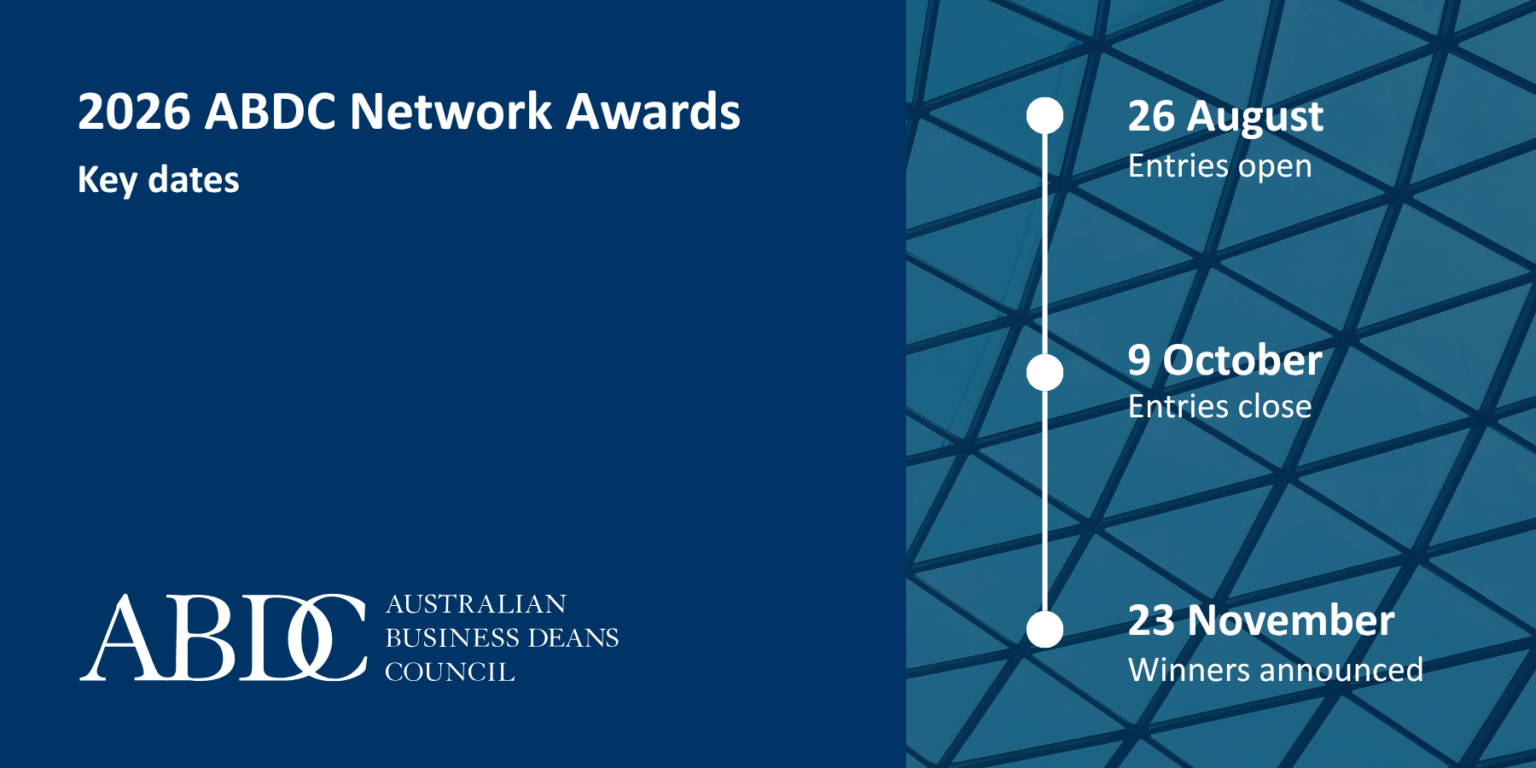
Applications for the 2026 awards close on 9 October.
We will be announcing the winners at the ABDC 2026 Conference on 23 November.
General eligibility criteria
In determining their eligibility, potential applicants must note that:
- Individual and teams may apply for an award, unless stated otherwise. A maximum of ten (10) people can be included on a team application and need not be employed at the same institution.
- Only professional and academic staff employed in a permanent or fixed-term role at an ABDC member business school for 12 months or more may apply for an award. Casual staff are ineligible to apply.
- Past winners are ineligible to apply for the same award for three (3) consecutive years.
Application form
Applicants are to provide the following information via the online form, noting that incomplete applications will be deemed ineligible for consideration. Unless stated otherwise, the online application form asks for:
- Applicant contact details;
- A short description of the initiative or research for which the applicant is seeking an award (50 words max);
- An outline of how the initiative or research was implemented, including an explanation of how it meets the award criteria (250 words max per criteria);
- Evidence of the measurable outcomes that have resulted from the initiative or research (250 words max); and
- A declaration that the applicant’s PVC or Dean supports their application.
ABDC Award for Innovation and Excellence in International Engagement
This award recognises outstanding and innovative initiatives that have advanced international engagement and created strategic value for business schools and their partners. Eligible initiatives may enhance inbound, outbound or collaborative international education and/or engagement, including student recruitment, student mobility, transnational education, industry engagement, or other forms of international collaboration.
Award criteria
- Innovation: How does the initiative demonstrate originality in addressing a significant challenge or opportunity in international engagement? Consider innovation in strategy, partnership models, technology, pedagogy, governance or student experience.
- Sustainability and scalability: To what extent can the initiative be sustained over time, adapted to changing contexts, replicated in other settings or expanded to achieve greater impact?
- Institutional commitment: To what extent has your institution supported the initiative through leadership, policy, resources, recognition, or integration into institutional strategy?
- Strategic impact and value creation: To what extent has the initiative created measurable value for the institution, partners and stakeholders, and advanced institutional or sector-wide internationalisation priorities? Evidence may include student outcomes, partnership quality, research impact, capability development, reputation enhancement, financial sustainability, policy influence, or adoption of the initiative by others.
- Quality and evidence of excellence: What evidence demonstrates that the initiative has achieved outstanding outcomes? Evidence may include measurable performance indicators, benchmarking, external recognition, stakeholder feedback, independent evaluation or scholarly evidence.
- Stakeholder and societal impact: How has the initiative created a positive impact for students, staff, partner institutions, industry and broader community? Consider reciprocal benefit, inclusion, equity and long-term partnership outcomes where relevant.


ABDC Award for Innovation and Excellence in Research Impact
Award criteria
Excellence in research will be judged based on the completion of the ABDC Societal Impact Framework heatmap.
Up to two awards will be given, recognising individual emerging researchers (levels A, B and C), or individual senior researchers (levels D and E). Applications should clearly indicate the level of the researcher applying.
The criteria for the research awards are:
- Research rigour and excellence: Rigour and credibility of research underpinning the impact, evidenced by quality of publication outlets. Evidence that the research is responsible and aligned with ethical integrity principles.
- Co-design and engagement: Evidence of co-design with non-academic stakeholders, and stakeholder collaboration.
- Translation and reach: Evidence of dissemination beyond scholarly outputs (e.g. policy briefs, practitioner outputs, datasets etc).
- Impact and outcomes: Evidence ofclear outcomes (e.g. policy change; change in organisational practice; or economic, social, and/or environmental benefits), and strength of evidence.

ABDC Award for Innovation and Excellence in Business Education
Open to individuals or teams, up to two awards will be given in this category. If your initiative relates to employability, please apply for the Excellence in Employability and Work-Integrated Learning Award. If your initiative is offshore delivery, please apply for the International Engagement Award.
Award criteria
- Demonstrated impact on learning: what evidence is there that the initiative improved learning outcomes, progression, engagement or student experience? Draw on at least two sources of evidence.
- Innovation, assessment and academic integrity: how innovative is the design, pedagogy or use of technology, and where assessment is involved, how has it strengthened integrity or students’ capability to use generative AI responsibly?
- Inclusive practice: what design decisions supported students from under-represented groups, and what suggests they worked? Provide outcome data by equity group where you have access to it.
- Scholarship and transfer: how did the initiative draw on the teaching and learning literature, and how has the initiative been adopted, adapted or transferred beyond its original setting?
ABDC Award for Excellence in Employability and Work-Integrated Learning
Open to individuals or teams, one award will be given in this category.
Award criteria
- Demonstrated employability impact: what evidence is there of improved professional capability, confidence, employment outcomes or transition into work?
- Quality and reciprocity of partnership: what evidence is there of genuine co-design with industry, government, professional bodies or community organisations, and of value returned to them?
- Access and inclusion: how does the initiative reach students who cannot easily take up a conventional placement?
- Authenticity, rigour and transferability: how is the experience situated in real practice and integrated with curriculum and assessment, and what suggests it is sustainable and replicable?
ABDC Award for Emerging Educators
One award will be given in this category, which is open to individuals.
Nomination-based: to apply, provide a nomination letter of 250 words, plus two endorsements.
An endorsement is a short confirmation from a colleague, student or industry partner that they support the nomination. Career interruptions are excluded from the five-year calculation, and career stage is taken into account.
Award criteria
- Demonstrated impact on learning: what evidence is there that the nominee’s practice improved student learning, engagement or experience?
- Innovation and professional judgement: what shows creativity and sound pedagogical judgement, including in assessment and the use of new technologies?
- Inclusive practice and trajectory: what evidence is there of inclusive teaching, and of growing contribution beyond their own classroom?

ABDC Award for Innovation and Excellence in Professional Management
This award recognises initiatives that demonstrably improve the management of ABDC member business schools.
Award criteria
- Innovation: How innovative is the initiative in its aims, design and implementation?
- Excellence: Evidence of the underlying excellence of the initiative.
- Scalability: Can this initiative be deployed in other areas of the university or at other institutions? For example, beyond the business school there may be evidence of broader institutional support for the initiative.
- Impact: How has this initiative improved management practices in your school? This could be through delivery of cost savings, removing frictions in processes, or contributing to staff and student experience.

ABDC Award for Transformative Action and Innovative Approaches to Climate Change
The ABDC is committed to assisting business schools to educate the next generation of business leaders about the importance of a net zero future for Australia and to advance research on business responses to climate change.
This award recognises transformative initiatives led by business schools with high potential for climate positive and sustainability impacts.
Award criteria
- Innovation: How innovative is the initiative in terms of its aims, design, approach, and delivery?
- Scalability and replicability: What potential does the initiative have to be scaled up or replicated in other contexts?
- Engagement and/or collaboration: Is there evidence of engagement and/or collaboration with academic and non-academic stakeholders?
- Transformative action: How has the initiative had or is expected to have demonstrable positive impacts on climate and society?